At the Summer School of AI and Cybersecurity held at Khalifa University under the Google.org Grants initiative, our Special Advisor and Principal Investigator Dr. Luigi Martino delivered a thought-provoking keynote on one of the defining challenges of our time: the ethical questions surrounding AI adoption. Addressing more than 700 students and professionals, Dr. Martino examined how the rapid integration of AI into organizations and everyday life demands not just technical competence, but ethical clarity.
Ethical Questions Regarding AI Adoption

KEYNOTE ADDRESS BY DR. LUIGI MARTINO — SUMMER SCHOOL OF AI & CYBERSECURITY, KHALIFA UNIVERSITY
What Is AI Adoption?
Artificial Intelligence refers to computer systems that can perform tasks normally requiring human intelligence — learning, reasoning, problem-solving, and decision-making. AI adoption is the process of integrating these technologies into organizations, products, services, and everyday activities.
As AI becomes more deeply embedded in society, its impact extends well beyond efficiency gains and automation. The decisions AI systems make — and the values embedded within them — increasingly shape outcomes for individuals, communities, and institutions. Dr. Martino's keynote framed three foundational ethical pillars that must guide responsible AI adoption.

Dr. Martino addressing the Summer School audience

Attendees of Keynote
Three Pillars of Ethical AI
01
Fairness & Bias
Ensuring AI systems produce equitable outcomes and do not perpetuate or amplify existing societal biases.
02
Privacy & Data Protection
Safeguarding personal and organizational data and ensuring individuals retain meaningful control over their information.
03
Accountability & Human Oversight
Establishing governance frameworks that keep humans in control of critical decisions and maintain transparency in AI systems.
Fairness and Bias in AI Systems
AI systems learn from data — and data is never neutral. It reflects the history, assumptions, and inequalities of the world in which it was collected. Dr. Martino emphasized that when training data contains historical biases or inaccuracies, the resulting AI can produce unfair outcomes that disadvantage certain individuals or groups, often in high-stakes areas such as hiring, lending, healthcare, and law enforcement.
Addressing bias in AI requires action at multiple levels:
- Auditing training datasets for demographic imbalances and historical inequities
- Designing evaluation metrics that measure fairness across different population groups
- Involving diverse teams in the development and testing of AI systems
- Establishing regulatory frameworks that hold organizations accountable for discriminatory AI outcomes
- Continuously monitoring deployed AI systems for emergent bias over time
AI fairness discussion

Panel
Keynote Attendees
Privacy and Data Protection
Many of the most powerful AI systems depend on vast quantities of personal and organizational data to function effectively. Dr. Martino raised a series of critical questions that every organization deploying AI must be able to answer: What data is collected? How is it used? Who has access to it? And do individuals have meaningful control over their own information?
Maintaining transparency around data practices is not merely a legal requirement — it is a foundation for public trust. Without clear answers to these questions, AI adoption risks eroding the confidence of the very users and communities it is intended to serve. Key principles Dr. Martino outlined include:
- Data minimization — collecting only what is strictly necessary for the intended purpose
- Informed consent — ensuring users understand and agree to how their data will be used
- Transparency in data pipelines, including third-party sharing and storage practices
- Strong technical safeguards such as encryption, access controls, and anonymization
- Clear mechanisms for individuals to access, correct, or delete their data
Accountability and Human Oversight
As AI systems are increasingly trusted to make — or meaningfully influence — decisions that affect people's lives, a fundamental question emerges: who is responsible when something goes wrong? Dr. Martino argued that accountability cannot be diffused across algorithms; it must remain with the humans and organizations that design, deploy, and govern AI systems.
This requires robust governance frameworks that ensure AI operates in a transparent, safe, and explainable manner. Humans must remain meaningfully involved in critical decisions, with clear escalation paths when AI recommendations are challenged or found to be incorrect.
As AI continues to advance, addressing ethical questions will be essential to maximizing its benefits while minimizing potential risks to individuals and society. Technology without ethics is not progress — it is risk at scale.
Dr. Martino's keynote closed with a message to the next generation of AI and cybersecurity professionals in the room: technical excellence alone is not enough. Building AI systems that are trustworthy, equitable, and accountable is both a professional responsibility and a moral imperative — and it begins with asking the right questions before writing a single line of code.
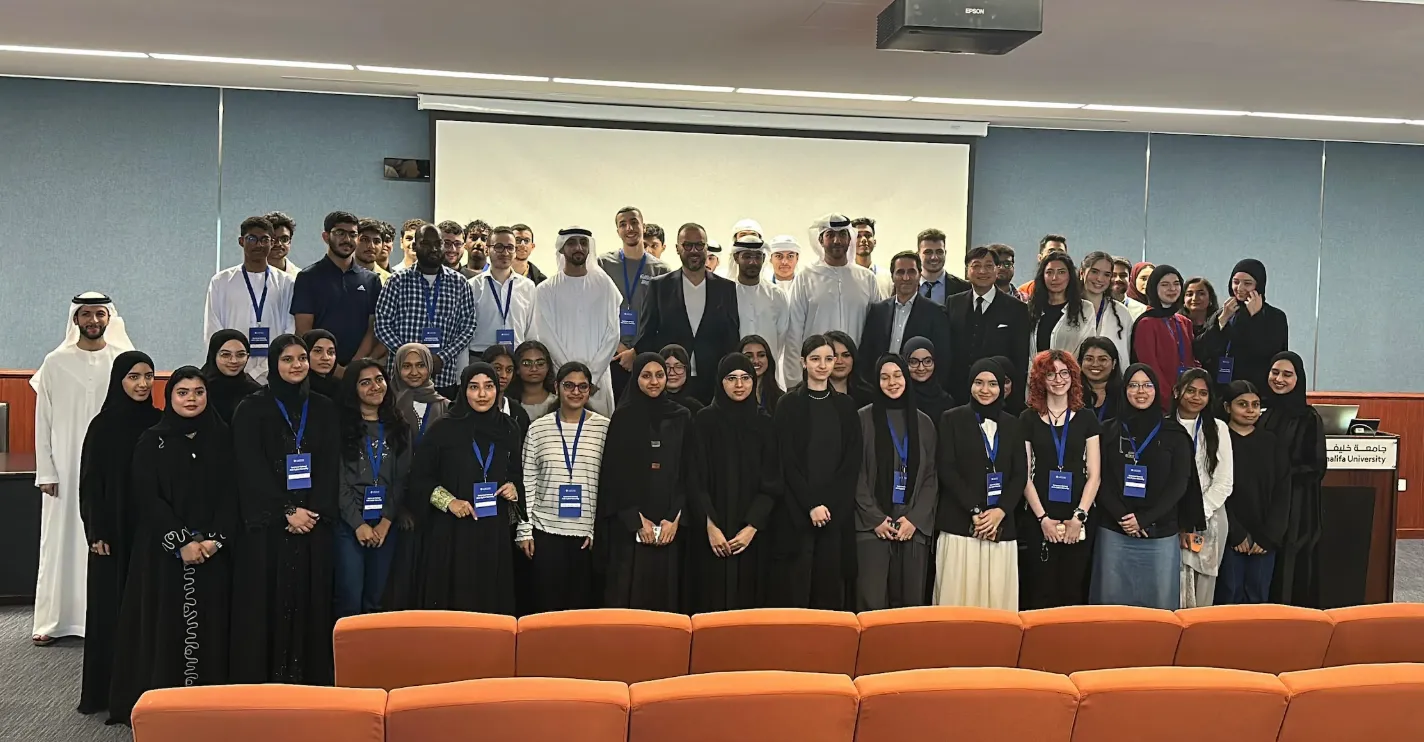
GROUP PHOTO — STUDENTS, FACULTY, AND INDUSTRY PARTNERS AT KHALIFA UNIVERSITY